


Credits

Shreyash Chhatbar

Divyesh Vasani
Founded
2026
Location
Chennai, India
Company size
10-50
Industry
Cloud & AI
Capabilities
Website

Alnatum engineers data, AI, cloud and productivity platforms for regulated enterprises across financial services, healthcare and life sciences, retail and manufacturing. It works Azure-first, with AWS capability for multi-cloud estates, and takes a platform from the first architecture decision through to 24x7 managed operations.
When Alnatum came to us, it had two founders with deep experience in enterprise technology and regulated industries, and no brand yet. We built the brand and the website from scratch.
The buyers it wants are careful by profession. A bank or a pharma company checks a new partner before it takes a meeting, and the website is where that check starts. A new name with a thin site reads as a risk, however good the engineers behind it are.
So the first version had to read like an established partner, not a launch.
The brief
The mandate was to build a brand and a website that matched the strength of the team and the seriousness of the work.
That is harder than it sounds without a brand to start from. There was nothing on the page yet to borrow trust from, and the category is crowded. Every cloud consultancy says it modernizes, migrates and optimizes, and most of them say it in the same blue.
We focused on three things: sharper positioning, stronger category cues and a more credible first impression. All three had to show up in the identity and on the site at the same time, because a buyer meets both at the same time.
Why design the brand and the website together?
The usual order is brand first, website later. The brand is signed off as a document. Months later someone tries to make it work on real pages, and finds out which parts do not survive a long headline, a dense list of services or a phone screen.
Alnatum’s brand and website were one project instead, with one designer leading both. Shreyash Chhatbar led the branding and designed the site. Divyesh Vasani built it in Webflow.
So nothing had to be translated from one to the other. The orange-to-teal gradient in the mark is the one that picks out a key phrase in every section headline on the site, and the brand’s serif sets those headlines.
Where did AI fit into the branding?
We do not take many branding projects. Alnatum was one of the few, and the process was AI-first.
We used OpenAI and Google DeepMind’s Nano Banana early, to open up concept directions. Then we took those directions into sketching. Then Shreyash decided what stays and what goes.
The order is the point. The models are fast at widening the field and have no opinion about which option is right. The narrowing is where a brand gets its point of view, so that part stayed with a designer.
One gradient, from the mark to every headline
The mark is a rounded square with a white A at its center, filled with a gradient that runs from orange into teal. The wordmark is set in lowercase, and in color the same gradient runs across it.

The mark and the lowercase wordmark. One gradient, orange into teal, runs through both.
Orange is #F15A2B and teal is #007787. The rest of the palette is mostly neutral, a deep teal-black, a near black and an off-white, so the two brand colors stand out wherever they appear.
The guidelines run to six chapters: typography, iconography, patterns, colors, logo and imagery. The pattern is a set of layered bands that sweep from orange into teal. Photography is treated as duotone in the two brand colors, so any image placed on the brand looks like it belongs there.
Then the applications, where a brand either holds or falls apart: a screen, a co-founder’s business card, and posters written for Life Sciences and Healthcare.
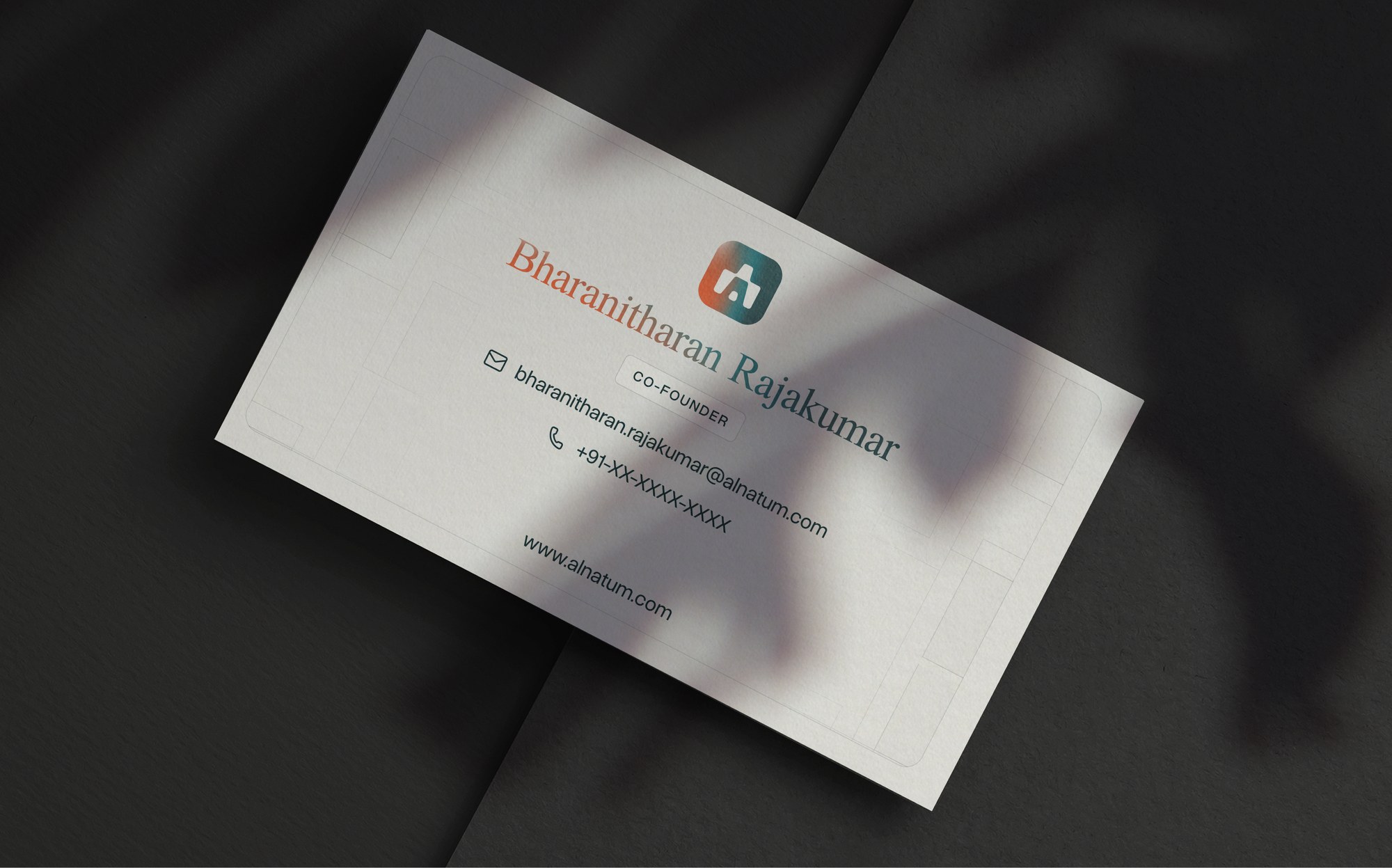
A co-founder’s card, with the name set in the serif and the gradient running through it.
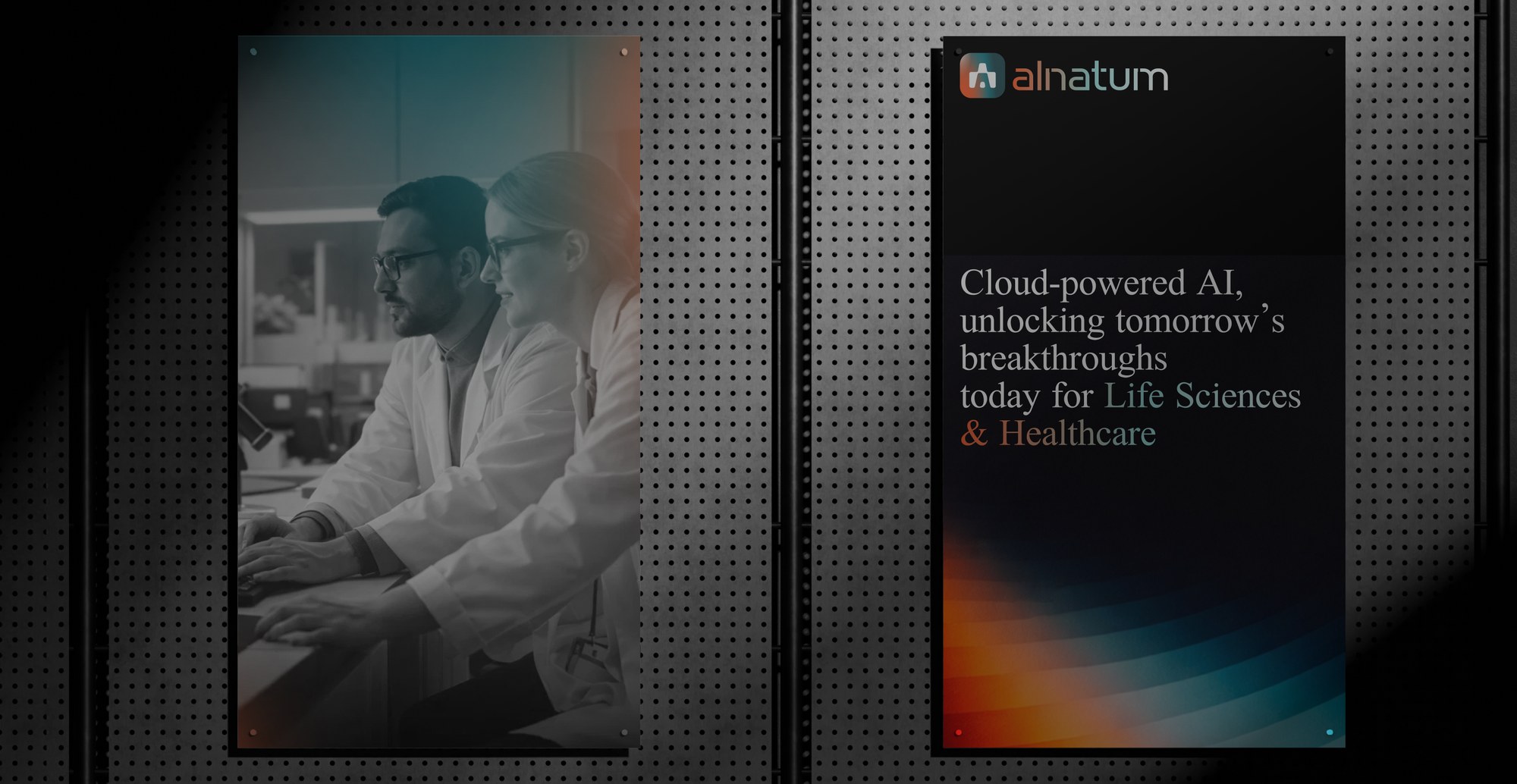
Duotone photography and the layered band pattern, on posters written for Life Sciences and Healthcare.
How did the brand carry into the website?
The homepage opens on the position in one headline: “Cloud-native by birth. Compliance-ready by design.” The gradient sits on one word only, Compliance-ready, because in a regulated industry that is the word a buyer is scanning for.
That rule runs down the page. Every section headline carries the gradient, usually on a single phrase: across the cloud, across the value chain, weeks into hours, run in production. On dark sections a lighter version runs from orange through pale teal to white, so the phrase keeps its contrast.

A key phrase in each headline carries the gradient, on dark sections and light ones.
On the page, category cues are names, not adjectives. Near the top sit the Microsoft Solutions Partner status and the platforms it is aligned with: Azure AI Foundry, Microsoft Fabric and Azure Landing Zones. The services name Azure OpenAI, Databricks, Synapse and Purview. A CTO can tell which stack this company works in before reading a full paragraph.
Alnatum’s own record is set in large numerals in the brand gradient: 12+ GenAI, ML and data projects delivered, 40+ projects on the Azure stack, 24x7 managed-service coverage. The accelerator section carries small data visuals in the same colors. Industries sit on four tabs, from Financial Services to Manufacturing and Industrial, and the active tab’s icon takes the gradient as its stroke.
Divyesh built the site in Webflow with the palette and both typefaces set up as site-wide variables: a serif, Scheherazade New, for section headlines and a grotesk, Overused Grotesk, for text. A new section starts on-brand instead of being matched by eye.
What it adds up to
Alnatum started with a name. It now has a mark and a wordmark, a palette, two typefaces, a pattern, a photography style and the guidelines that hold them together, and a website built from the same parts.
The first version of the brand looks as serious as the work it describes, which was the whole brief. Suchithra Mary Ann Hormese, Alnatum’s co-founder, described the result as an outcome “completely aligned to our vision and goal.”
“Thank you team Rango and Sagar Ludhiyani, Divyesh, Shreyash for the professional approach and the collaborative efforts to provide an outcome that was completely aligned to our vision and goal. Would highly recommend team Rango!”

Branding and website design by Shreyash Chhatbar. Webflow development by Divyesh Vasani. Thanks to Alnatum’s founders, Bharanitharan Rajakumar and Suchithra Mary Ann Hormese, for trusting us with both.
Common questions
What does Alnatum do?
Alnatum is a cloud and digital transformation partner that engineers data, AI, cloud and productivity platforms for regulated enterprises. Its core is Microsoft Azure, with AWS capability for multi-cloud estates, and its work covers generative and agentic AI, data and analytics, migration and modernization, and 24x7 managed services. It is based in Chennai, India.
What did Rango do for Alnatum?
Rango built Alnatum’s brand and website from scratch. That covered the mark and wordmark, color, typography, pattern, photography style and brand guidelines, the positioning and design of the website, and the Webflow build.
Why design a brand and a website at the same time?
Because a brand only proves itself on real pages. With one designer leading both, the person who set the gradient, the type and the color rules also applied them to the site. The guidelines and the website came from the same hands. It also means the brand and the site launch together, consistent from the first day.
Can AI design a brand identity?
It can widen the options, but on Alnatum it did not decide them. We used OpenAI and Google DeepMind’s Nano Banana early to open up concept directions, took those into sketching, and Shreyash Chhatbar decided what stayed and what went.
Does Rango take on branding projects?
Rarely. We do not take many branding projects, and Alnatum was one of the few. Most of our work is websites, products and front-ends for B2B companies, and here the brand was built alongside the website.
What is the Alnatum website built in?
Webflow. Divyesh Vasani built it with the brand palette and both typefaces set up as site-wide variables, so new sections start from the same system.
Share on
Previous