

Credits

Amit Pathania

Md Shahanab Uddin

Divyesh Vasani
Founded
2024
Location
Dover, Delaware, USA
Company size
11-50
Industry
Healthcare AI
Capabilities
Website

Rx is the prescription. The Rx Assistant is what sits in the gap between a prescription being written and a prescription being filled, which is where they get lost. It answers patients and prescribers in chat, voice and SMS, around the clock: what a medication will actually cost, whether insurance covers it, how to start therapy, when to refill. Eleven pharma brand marks sit in its trust row, among them GoodRx, Otsuka, GSK, Amneal, Boehringer, Currax and Tarsus.
It works inside each brand’s own channels, under the brand’s name rather than its own. Every patient it has ever helped has used it. None of them have heard of it.
That is the problem we were hired to solve.
The brief
One landing page. Make an invisible product legible to five separate teams inside a pharma company, all of whom have to say yes before anything moves.
Enterprise pharma does not have a buyer. It has a committee that never meets. Marketing wants pull-through on the brands they are already paying to advertise. Market access wants fewer patients abandoning at the pharmacy counter over cost. Commercial operations wants field coverage without adding headcount. Medical affairs wants to know that nothing said to a patient falls outside approved language. Patient support wants the hours nobody staffs.
Five questions, five vocabularies, one page. A generic “AI for healthcare” pitch loses all five at once.
Naming the buyer on the page
So we stopped writing to a persona and wrote to the five teams by name, each with the sentence that team actually needs to hear. Marketing and brand get pull-through. Market access and patient services get access barriers removed at scale. Commercial operations and the field force get reach without headcount. Medical affairs gets always on and always compliant. Patient support and hub services get the hours after five.
Naming them does two things. Whoever lands on the page finds their own row inside a few seconds, and the person who forwards the link internally has something to point at. In a committee sale the site is not read once by one person. It is circulated, and it has to survive being read by someone whose concerns are nothing like the first reader’s.
A product with nothing to screenshot
The usual move for a software site is to show the software. That was not available here. The product has no interface of its own worth showing, because it deliberately wears the client’s brand, and the parts that are visible are a chat window, which every AI company on earth is currently putting on its homepage.
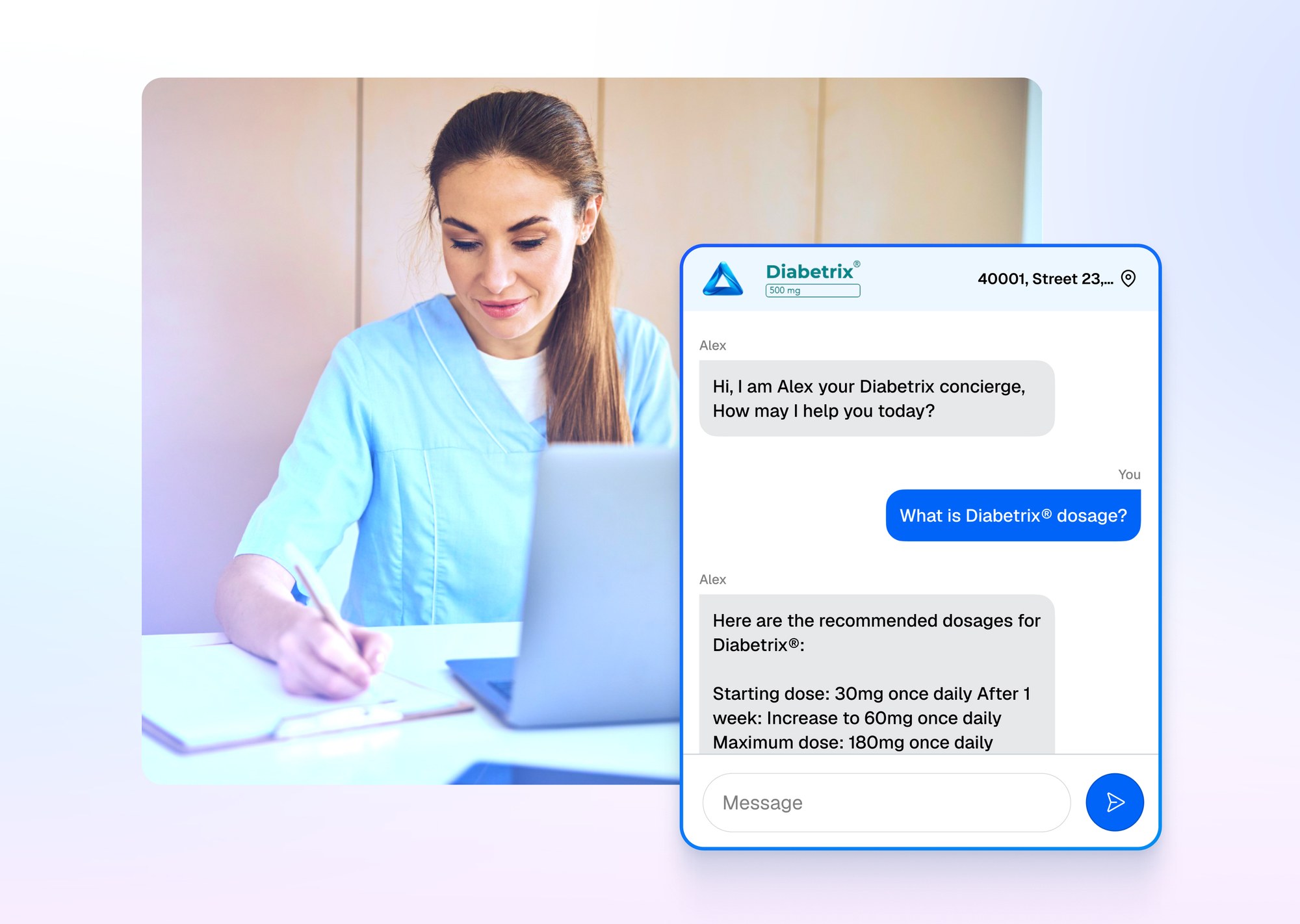
It runs under the client’s brand rather than its own. Here it is working as Diabetrix.
What is distinctive is not the interface. It is the journey the interface covers, and how much of that journey is unglamorous back office work.
So the product is shown three ways in one module rather than three pages. The patient journey, from a first question about a medication through finding a treatment center, benefit verification, cost clarity, enrollment and refill reminders. The prescriber journey, from approved product information through sample requests, dosing guidance and a route to a medical science liaison. And the internal work that nobody puts on a homepage: automating prior authorization calls to payors and pharmacies, retrieving MLR-approved content, pharmacovigilance reporting, analytics on every interaction.
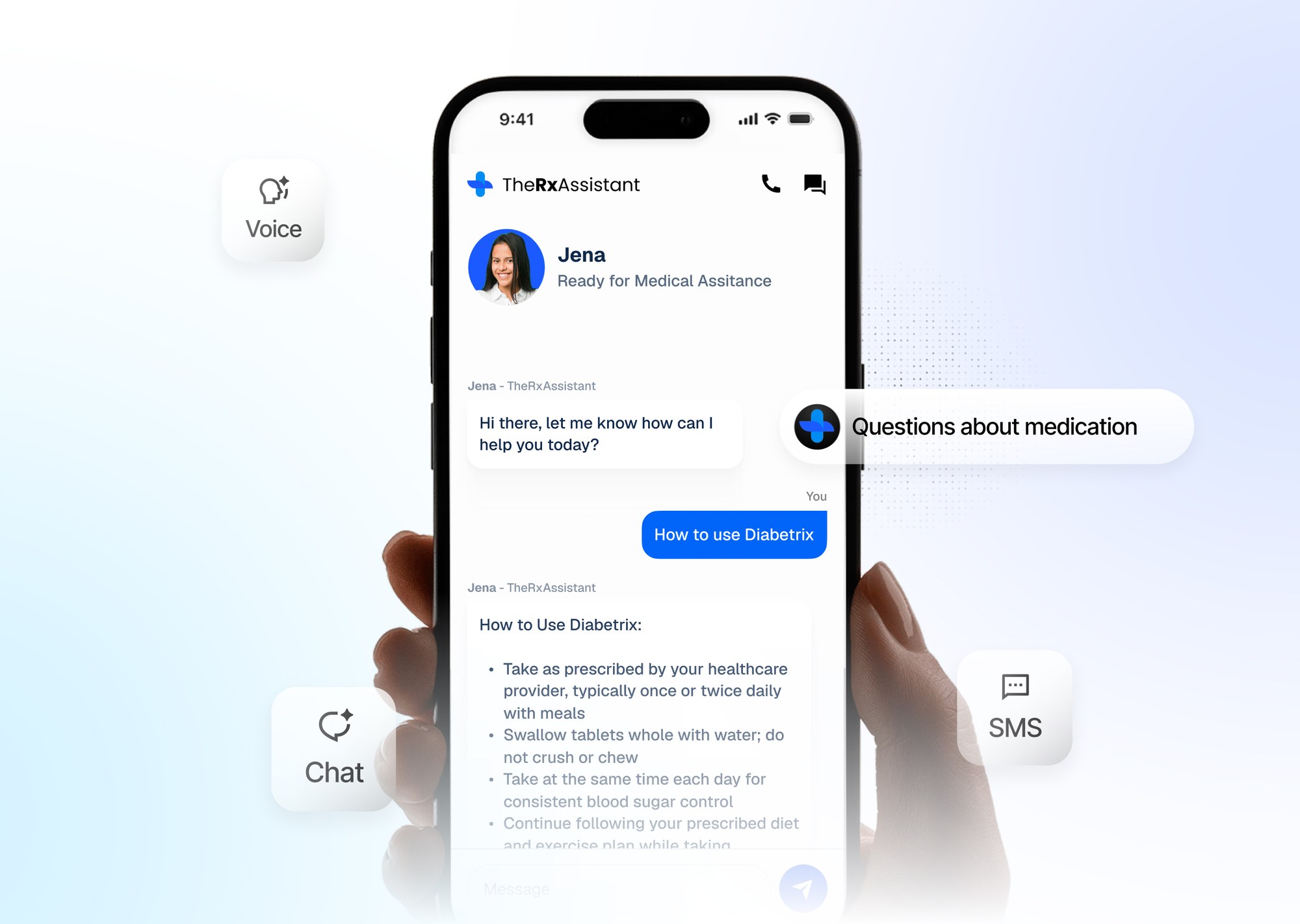
Chat, voice and SMS, in the patient’s hands, at whatever hour the question actually arrives.
The third one matters most and sells hardest, because it is the part a pharma operations lead recognizes as their actual week.
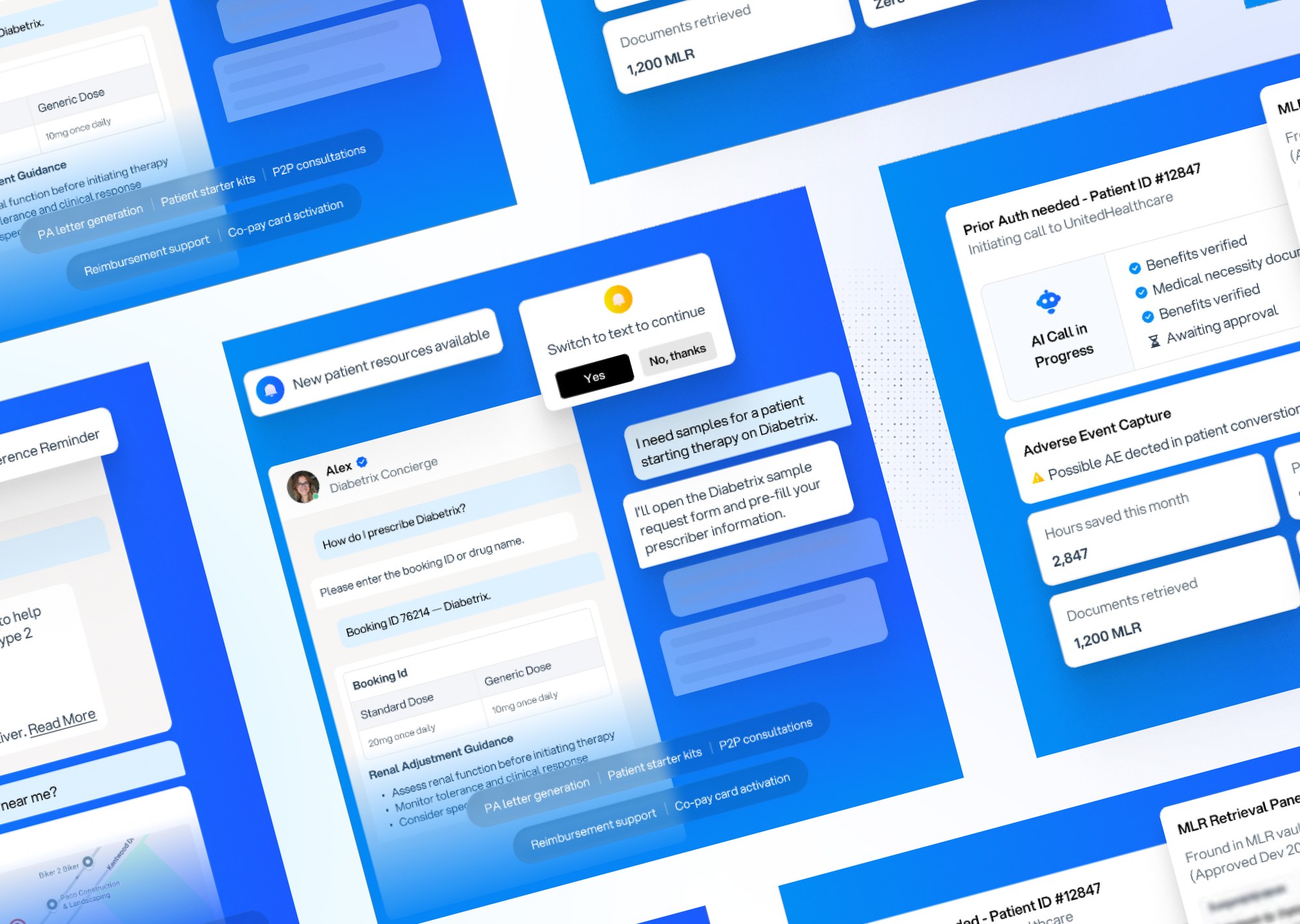
Prior authorization calls, adverse event capture, MLR retrieval. The part nobody puts on a homepage, and the part that sells hardest.
Proof does the arguing
In a regulated category, adjectives are close to worthless. Anything that sounds like a medical claim has to survive review, and the confident marketing language that works for most B2B software is exactly the language that gets a pharma page sent back.
So the page is built to let checkable things carry the weight. Eleven brands in the trust row. Integrations with Veeva, Epsilon and Salesforce, which tell an operations reader this will sit inside the stack they already run. HIPAA and SOC 2 badges in the hero rather than buried on a security page, because for this buyer compliance is not a footnote, it is the first question.

Four pillars on a dark band, with the compliance marks kept in frame rather than filed away on a security page.
Then the patient conversations, carried close to verbatim. A man of seventy-one in Denver who could not get an appointment for months. A woman of fifty-nine in Miami who already knew her prescription was not covered and wanted to know what it would take. Each ends with the patient thanking the assistant. That is quieter evidence than a statistic and it does more work, because it is the only place on the page where you hear what the product actually sounds like.
The client’s own platform numbers sit in the customer spotlight alongside a line from a Sr. Director of Marketing at a public pharma company: 3x engagement, a 42% reduction in support inquiries, 5x ROI, a 94% satisfaction rate. Those are The Rx Assistant’s results for their customers, not ours for them, and the page presents them that way.
Then the blog, built with Claude
The landing page was the first engagement. The blog was the second, and it was built differently.
We built it with Claude, on a Strapi headless CMS behind the existing Next.js front end. It runs as one section with two streams: original writing, and a newsroom of external coverage pointing out to PM360, MedCity News, MM+M and PRNewswire. Readers filter between them, and it paginates as the archive grows.
The reason for building it this way is the same reason the rest of the site works. A pharma communications team publishes on the rhythm of approvals and announcements, not on the rhythm of a development queue. Putting the content in Strapi means their team writes and ships without touching the front end, and the front end stays a Next.js build rather than becoming a page builder.
What it adds up to
A single page that a marketing lead, a market access lead, a compliance reviewer and an operations lead can each read and find their own reason to take the call, without any of them being told what embedded AI is first. And a publishing system the client runs themselves.
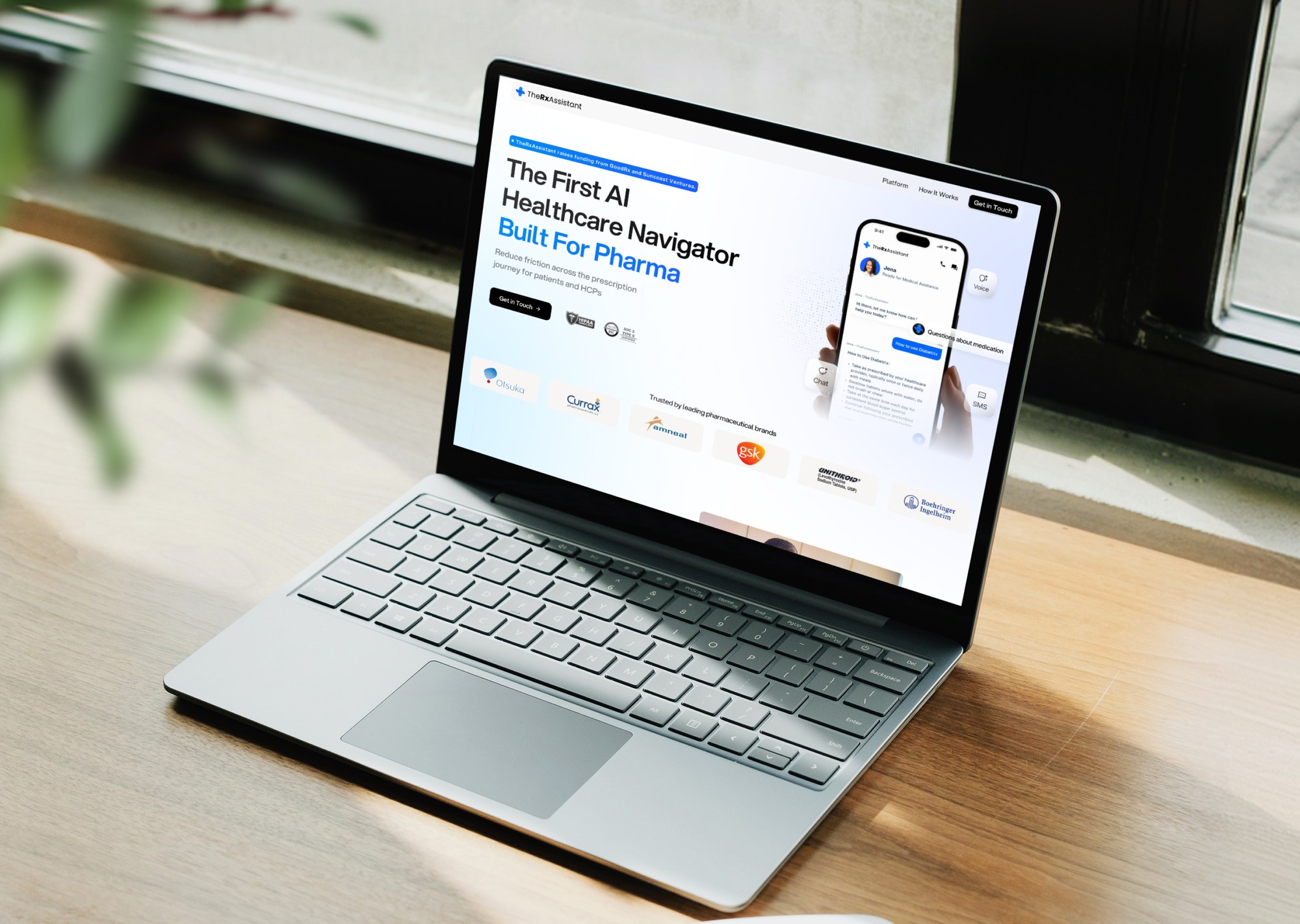
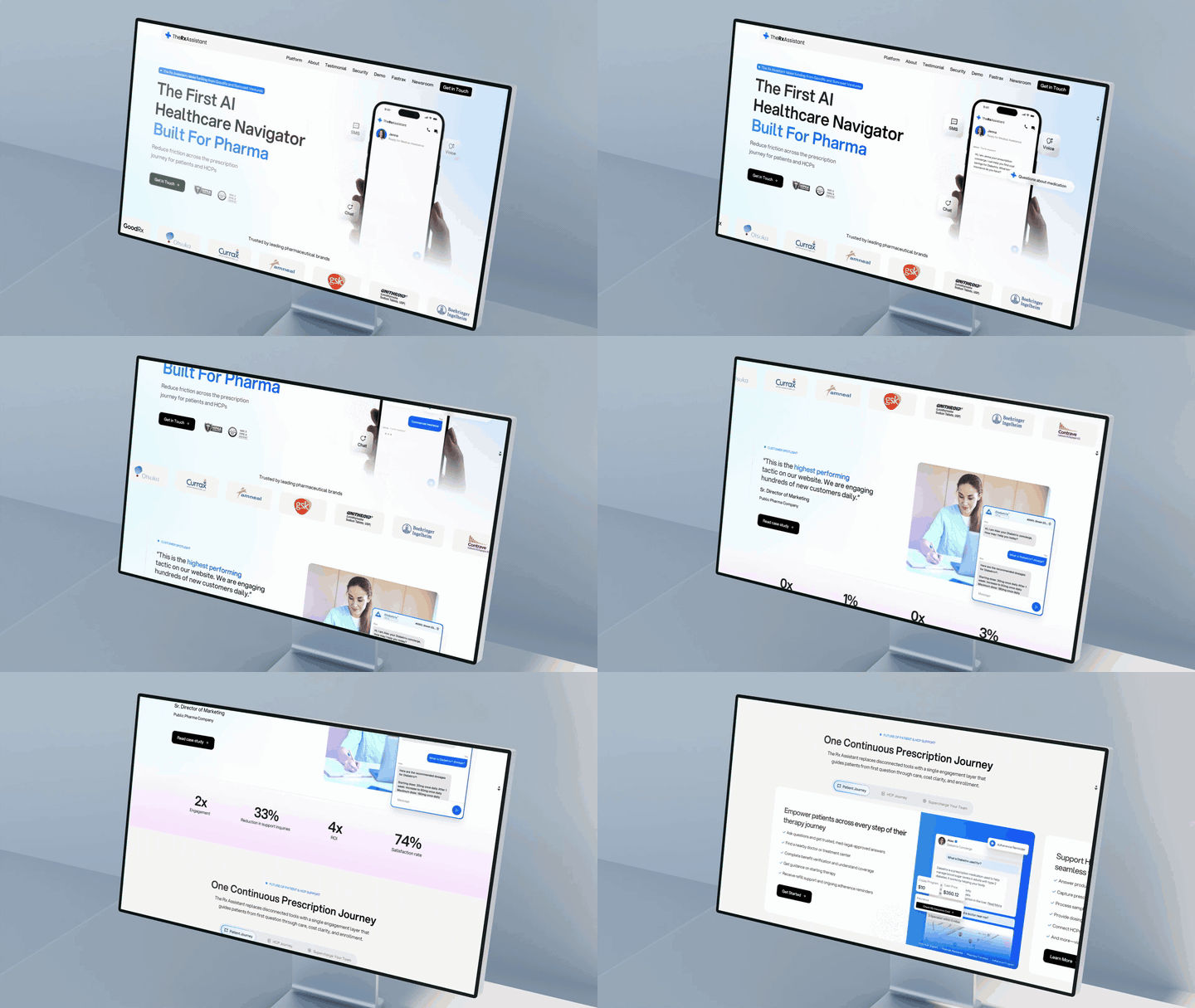
The landing page. One page that has to answer five teams before any of them will take a call.
Design by Amit Pathania and Md Shahanab Uddin. Development by Divyesh Vasani.
Common questions
What does The Rx Assistant do?
It is an AI healthcare navigator built for pharmaceutical brands. It supports patients and prescribers through chat, voice and SMS, 24/7, across the prescription journey: medication questions, finding a nearby doctor or treatment center, benefit verification, copay and patient assistance enrollment, guidance on starting therapy, and refill support. It runs inside each brand’s own channels rather than under its own name.
What did Rango design and build?
The landing page at therxassistant.com, and the blog. The landing page positions the product for the five teams inside a pharma company who each have to approve it. The blog was built with Claude on a Strapi headless CMS behind the site’s Next.js front end, and carries both original writing and a newsroom of external coverage.
Why is an AI product for pharma hard to put on a website?
Three reasons compound. The product is invisible, because it works inside the client’s brand rather than its own, so there is nothing distinctive to screenshot. The purchase involves five teams with five different questions and no single buyer. And it sits in a regulated category where confident marketing language is a liability, so verifiable proof has to carry the argument instead.
What is the site built in?
Next.js. The blog runs on a Strapi headless CMS behind the same front end, so the client’s communications team publishes without a developer.
Do you work with US healthcare and pharma companies?
Yes. The Rx Assistant is headquartered in Dover, Delaware. We work in USD, assign IP to the client, and handle MSAs and NDAs the way US companies expect.
Share on