
Webflow Conf 2026: Review Beats Generation

Webflow’s most important 2026 story was not an agent that generates more work. It was the review layer around that work.
The stage story was generation: sites, campaigns, landing page variants, ad creative, video cutdowns and animations. Most of that was unavailable when the conference ended, and some of it still has no date. The products that shipped on 2 September focused on the opposite problem. They encode standards and expose changes across breakpoints. Releases promises the production gate later.
We think the review layer matters more than the generation layer. A fast page generator only creates capacity when a team can define the standard, see the change, name an owner and stop bad work before it goes live. Not because generation is unimportant, but because in our experience unchecked generation turns speed into cleanup.
We build on Webflow for a living, and this is now the first question we ask on a new project. The tooling differs from client to client. The failure mode does not.
Webflow announced a generation layer and shipped a review layer
As of 5 September 2026, this is what readers can use now:
Visual editing for AI code components is live for all customers from 2 September. Users can style component elements, edit text and scope prompts to selected elements.
Component visibility controls and slot restrictions are live for all customers.
Components in the CMS began rolling out on 2 September, with all users expected to receive it within about a week.
Breakpoint canvas began rolling out on 2 September in Design, Build and Edit modes, with all users expected within about a week.
Agent Instructions generation began rolling out to everyone from 2 September.
Performance improvements are live for all customers. Canvas improvements shipped earlier in 2026, and Webflow Localize improvements are also live for all customers.
Webflow AEO agents are on by default for Enterprise customers. Analytics requires the latest Webflow Analyze for Enterprise, available now through an upgrade.
Campaigns is in beta.
Everything else is still ahead. Source is a limited research preview with phased enrolment over the coming months, and Assets has not entered beta. MCP 2.1 shipped on 21 September 2026. Agent Presence and default components for slots were also scheduled for September. Popovers and Agentic Translation are promised within a few weeks. Releases, more native primitives and style props for components are all set for later in 2026.
The shipped Builder tools are still early. Webflow says native support for repeating primitives such as sliders, tabs and accordions is only coming later this year, so component libraries built against today’s set will need revisiting.
Source points to a code-native future, but buyers cannot specify it
Source gives marketing teams and agents direct access to code, role-specific Views and connected tools. Code becomes the source of truth. Agents can attempt larger changes without forcing every role into a developer workflow.
A View is a dedicated surface for a job such as visual building, campaigns, content or optimisation. Teams can create Views for their own workflows. Agencies can package one View and install it across multiple projects.
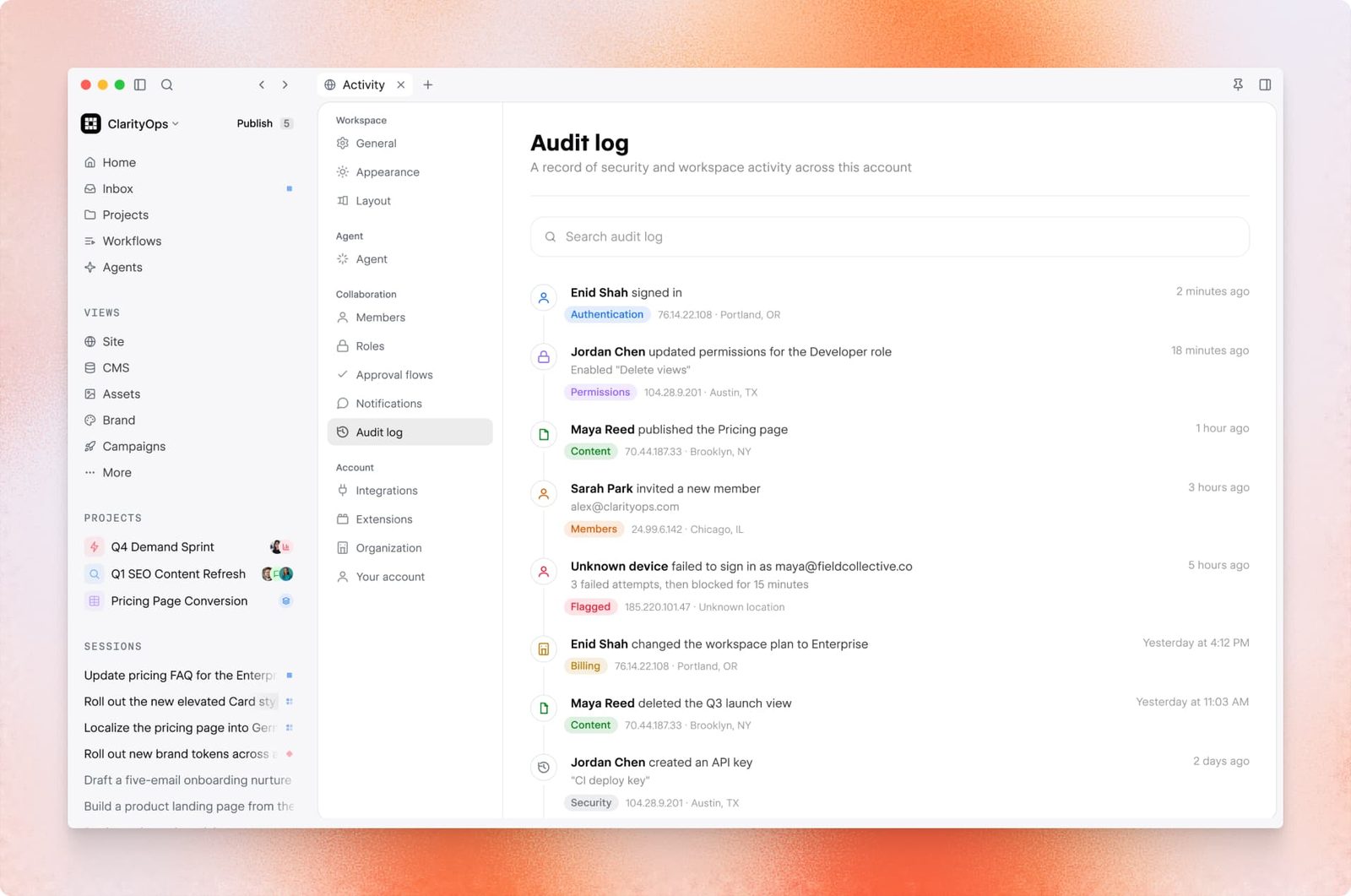
Source gives each role its own workspace. Screenshot: Webflow.
The composable platform connects an existing codebase, CMS, hosting and marketing tools, including existing Webflow sites. Webflow also offers its next-generation headless CMS within that stack. Existing Webflow remains live, and the company says “the platform you know and love isn’t going anywhere.” It promises a supported migration path, but gives no migration timeline.
Four agency partners appear in the announcement: 8020, Demandflow, Candid Leap and Flow Ninja. Candid Leap said Source would become its default for clients building on Next.js and Astro who need AI to work across the marketing team, not only through individual developers.
We are treating Source as a directional signal, not an immediate product choice. Source moves Webflow toward code-native infrastructure while keeping visual interfaces, permissions, approval paths and audit trails around the code. It has no published price, no general availability date and no dated migration plan. Applications are open, but selected agencies and customers will be enrolled gradually over the coming months.
Webflow’s timelines are too loose to plan against
Campaigns is in beta. Depending on which Webflow page you read, it is available for purchase next month, available later this fall, or coming soon. Assets is entering beta in October according to the announcement blog, and available early next year according to the press release. Neither product has a published price.
None of that is contradictory. October sits inside later this fall, and a product can enter beta in October and reach general availability early in the new year. It is simply too soft to build a plan on.
If your roadmap assumes Campaigns lands in October, or that Assets is production ready in the first quarter, you are planning against marketing language rather than a commitment. Get beta eligibility, production-use terms, support, price and general availability in writing before either product becomes a dependency. Until then, treat both as upside.
The Builder releases matter because work has to survive production
At the Builder keynote, Webflow said it had shipped 151 improvements since Webflow Conf 2025, almost all from user feedback. The releases address production work directly: editing, reusable content, responsive checking, localisation and speed.
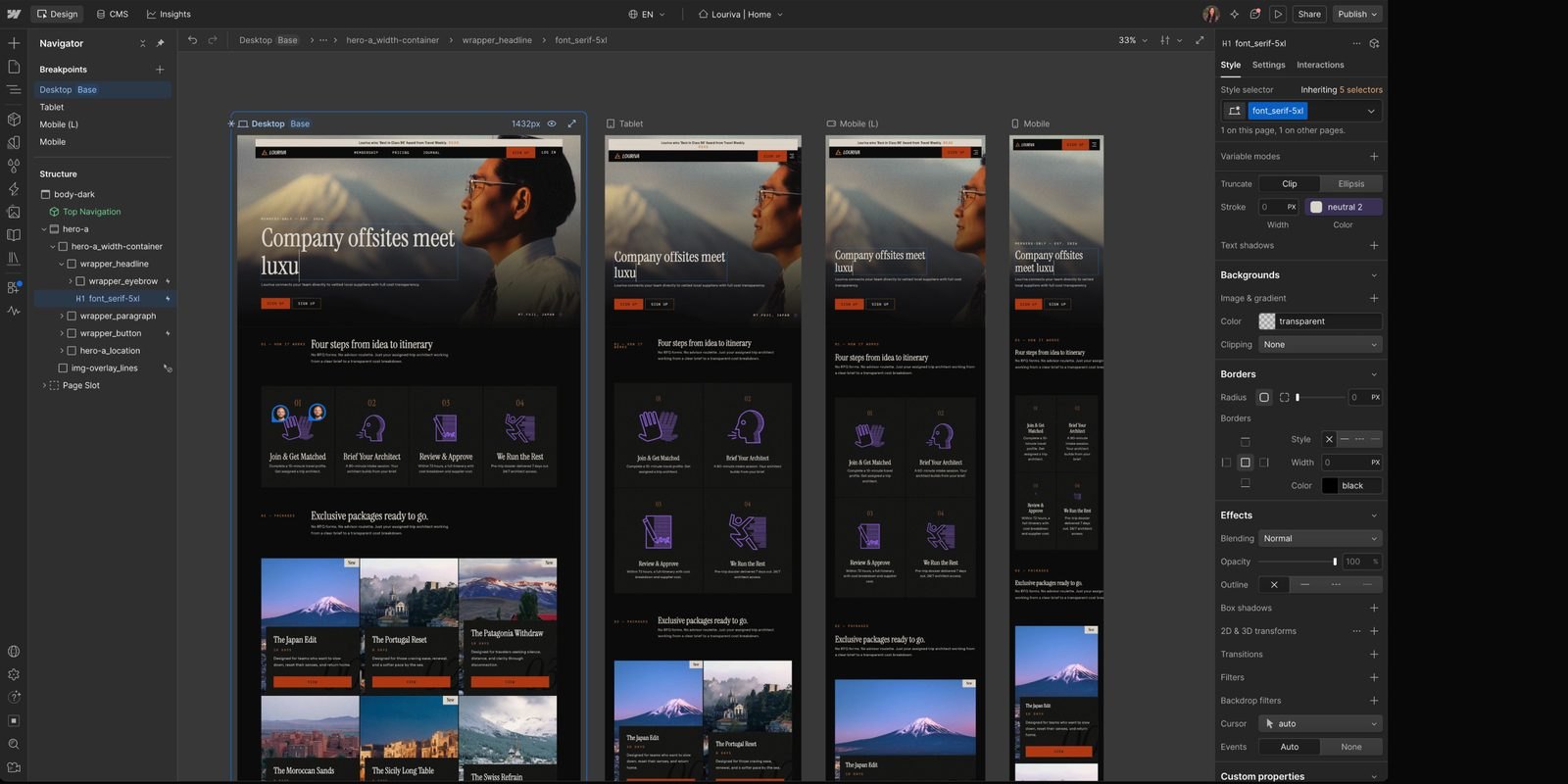
Breakpoint canvas shows desktop, tablet and mobile together. Screenshot: Webflow.
Webflow says copying large elements in Designer is up to 98 percent faster, pasting is 7.7 times faster, site rendering is up to 43 percent faster and publishing is up to 80 percent faster. These are Webflow’s figures, with no published methodology.
The opening keynote described a destination. The Builder keynote reduced friction we feel every week.
Governance becomes the product when generation accelerates
Webflow’s emerging system is a review stack. Releases will branch pages, CMS content, components, assets and locales, then place permissions around merge and publish. Agent Presence will show where an agent is working live. Agent Instructions generation drafts editable Brand Guidelines, Design System, Asset Guidelines and CMS Guidelines from the actual site.
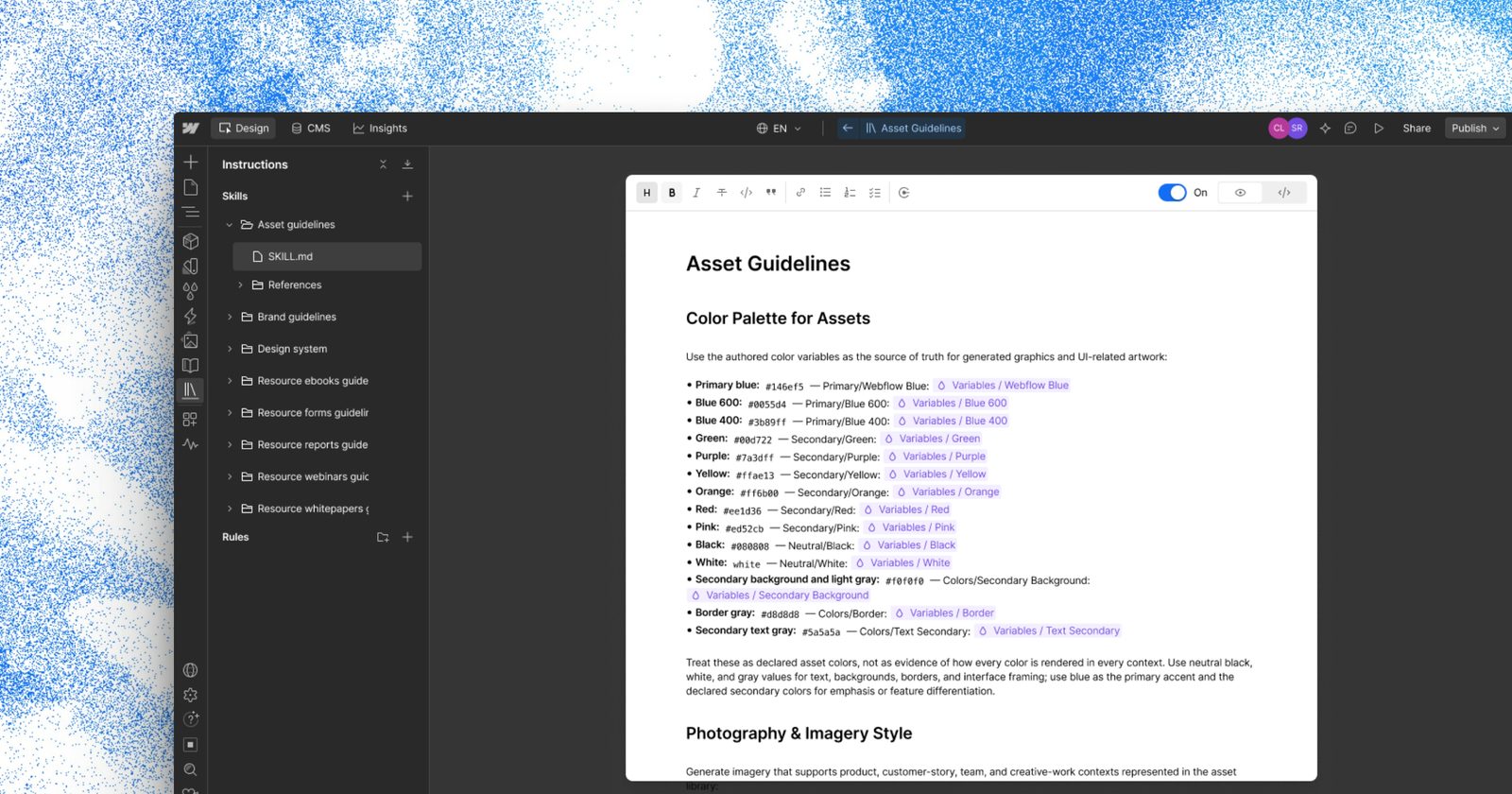
Agent Instructions generation drafts standards from the live site. Screenshot: Webflow.
Webflow states the principle plainly: “These guardrails apply whether your team is working directly in Webflow or agentically through our MCP, so a page template holds up no matter who is making the edit.” MCP 2.1 shipped to everyone on 21 September 2026. It adds GSAP and IX3 interactions, CMS sorting and filtering on custom and reference fields, and Webflow Cloud deploys from the agent. Branch merging with a staging preview is Enterprise only.
The 3 September programme made the same point. Steve Lavigne of Craft&Crew called the Claude connector “not a productivity tool” but “an accountability tool,” comparing it with a junior developer whose work the team owns. Kevin Wong argued that teams shipping the most agentic work made their standards machine-readable.
In August 2026, Webflow said more than 30 percent of its enterprise customers already run agents against live sites through its MCP. Those changes are reaching production now. Faster generation moves labour into specification, review and accountability. Without a machine-readable standard, visible changes and a named approver, an agent creates review debt at machine speed. That is the part we have had to solve on real builds, and it is why we read this conference as a governance release rather than a generation release.
Webflow’s AEO evidence shows signal, not causation
Webflow says its study of 2,000 company websites found that the median company appeared in 16 percent of the AI answers it wanted to appear in and was cited only 6 percent of the time. It did not publish the methodology.
Webflow also says its AEO customers received 70 percent more mentions and 120 percent more citations than non-Webflow brands. The directional internal comparison covered 158 customers that accepted recommendations and 187 that received but did not accept them, measured from 19 May to 13 July 2026. Webflow says so itself. Its footnote states the difference in organic traffic growth does not isolate AEO recommendations from other drivers, including seasonality, changes in search and answer engine indexing, marketing activity and site changes. That is honest labelling, and it is also exactly why the number cannot be read as proof the product caused the lift.
The 3 September session “AEO, one year in: what the data killed” said some tactics were overapplied and failed, many dashboards misled, and claims that everything changed were oversold. Measure visibility and citations. Do not confuse comparison with causation.
What we are doing about it this quarter
We are a Webflow Certified Partner and we run these builds for a living, so this is the list we are working through on our own client sites this quarter.
Use Agent Instructions generation to draft standards from the real site. Edit the markdown, assign an owner and review it as policy.
Turn on component visibility controls and slot restrictions. Hide irrelevant choices and restrict templates to approved components.
Add breakpoint canvas to responsive review. Check agent edits in Design, Build or Edit mode.
Use visual editing for AI code components to inspect the exact element changed. Scope follow-up prompts to that element and correct it on the canvas.
Define approval ownership before Releases enters beta later in 2026. Observe work when Agent Presence arrives, but keep a named human responsible for what ships.
The practical buying questions already have answers
Is Source available yet?
Source is available only in a limited research preview, with selected agency partners and customers enrolled in phases over the coming months. Applications are open, but there is no general availability date, price or dated migration plan.
Should we wait for Source before starting a Webflow project?
No. Existing Webflow is not being deprecated, and the promised migration path is not dated, so judge a current project against capabilities available now.
What actually shipped that we can use today?
Visual editing for AI code components, component visibility controls, slot restrictions and the stated performance improvements are live for all customers. Components in the CMS, breakpoint canvas and Agent Instructions generation began rolling out on 2 September. MCP 2.1 followed on 21 September, adding interactions, faster CMS queries and Webflow Cloud deploys for AI agents.
Is Webflow AEO worth it?
We would test it where answer-engine visibility genuinely matters, but measure against a baseline and against downstream results, not mentions alone. Webflow’s comparison is directional internal data and does not isolate its recommendations from other changes.
Does any of this change whether Webflow is the right platform?
It changes the evaluation criteria more than the answer. We still recommend Webflow where its current building and governance model fits the team, and never because the announced generation layer might fit later.
Rango is a Webflow Certified Partner. We are technology agnostic, and we design and build products, websites and front-ends for teams from startups through to enterprise.
Product screenshots in this article are Webflow’s own, taken from its Conf 2026 announcements post, its Source announcement and its Builder keynote recap.

Sagar Ludhiyani
Published On
Share on