
Global Fintech Fest 2026: AI Agents, Tokenised Bonds and a Quantum Warning
Global Fintech Fest 2026 ran from 8 to 11 September at the Jio World Centre and Trident in Bandra Kurla Complex, Mumbai. Seventh edition, inaugurated by Prime Minister Narendra Modi, themed Potential to Impact: Agentic AI, Tokenisation, Quantum.
Team Rango was on the floor. The launches are easy to list and we have listed them below. The pattern behind them is the more useful thing. In the agentic launches, such as Amazon Pay’s Smart wallet and the flight-booking agent on L&T Finance’s PLANET app, the party starting the payment is not a person tapping a screen. It is a piece of software acting inside limits a person set earlier.
That is a different problem from the one Indian fintech has spent ten years solving. Getting a person to complete a payment is something you can fix at the moment of payment. Getting a person to delegate a payment has to be fixed before the payment, in writing, in language they actually read.
Sagar filmed two short videos on the floor. The first is from day two, when the team was there for both days and open to meeting anyone in Mumbai over coffee.
The second is from the last day, with two takeaways for anyone planning to show their company at an event this size. We also posted both on LinkedIn.
When and where was Global Fintech Fest 2026 held?
GFF 2026 ran from 8 to 11 September 2026 at the Jio World Centre and Trident, Bandra Kurla Complex, Mumbai. It was the seventh edition. Prime Minister Narendra Modi inaugurated it on 8 September, his third consecutive appearance at the event.
The principal organisers are the Payments Council of India, the National Payments Corporation of India and the Fintech Convergence Council. The Government of India lists MeitY, the Department of Financial Services, the NEST division of the Ministry of External Affairs, NITI Aayog, the RBI, SEBI, IFSCA and PFRDA as supporting it.
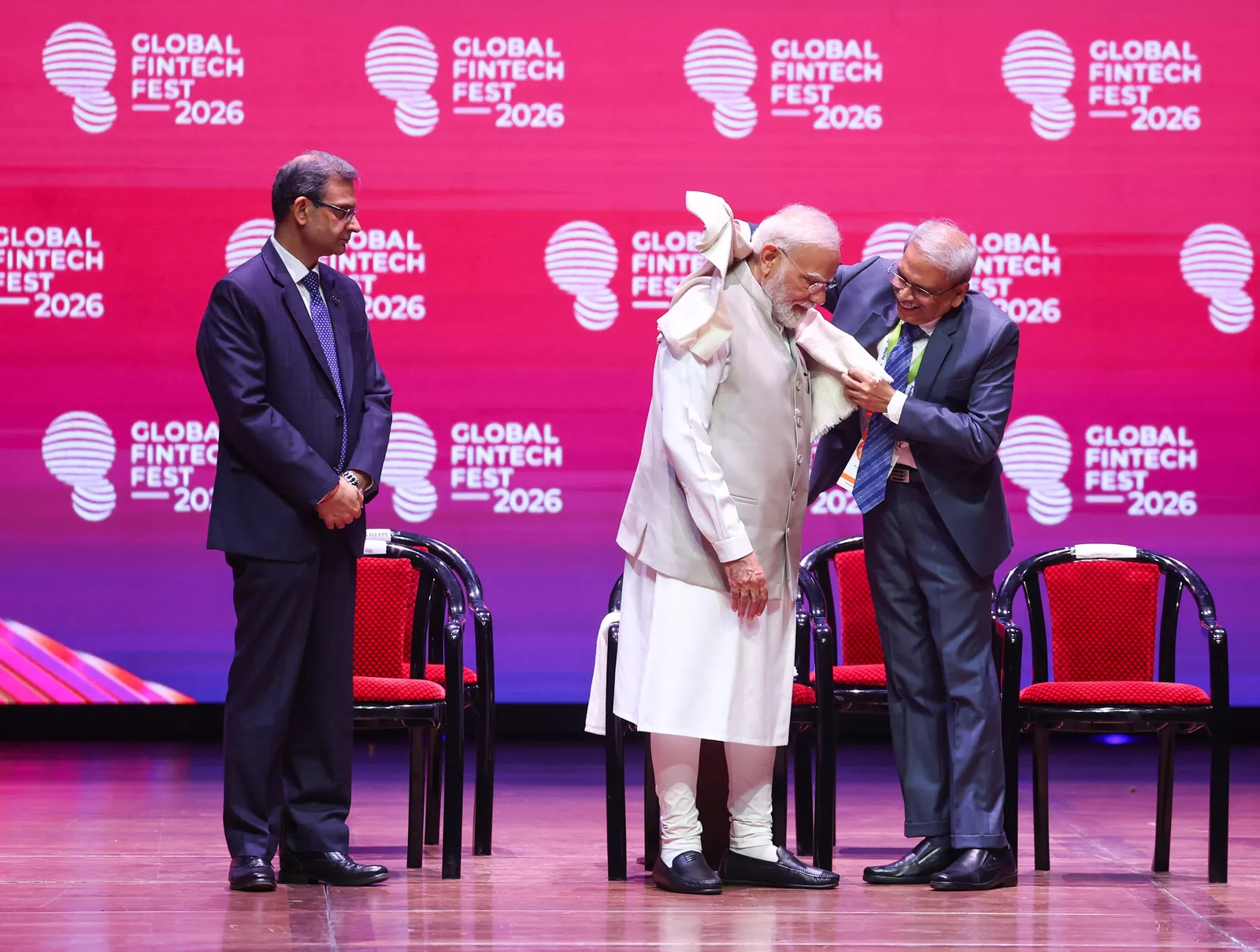
Narendra Modi is felicitated at the inauguration of Global Fintech Fest 2026 at the Jio World Centre, Mumbai. Photo: PMO India.
Be careful with the size numbers in circulation. The organisers promoted GFF 2026 with more than 100,000 footfall, 5,000 companies, 700 speakers, 400 investors and 70 countries. Those are the organisers’ own expectations, published before the event. We have not seen audited final attendance, so treat them as targets rather than results.
What was announced at Global Fintech Fest 2026?
The substantial launches came from NPCI, the RBI, the Department of Financial Services and the large payment platforms. The list below follows MediaNama’s reporting from the floor, published on 11 September.
NPCI launched AiNxt, an open-source agentic AI platform made up of AiNxt OS, Code, CLI and Enterprise, built on a bring your own models approach. NPCI launched AtOM, an orchestration platform that produces signed, machine-readable audit trails for UPI integration and partner onboarding. RBI Governor Sanjay Malhotra launched MyUPI, a consolidated view of a user’s UPI transactions and AutoPay mandates across banks and UPI apps. It runs on FiMI, NPCI’s payments-focused small language model. RBI Governor Sanjay Malhotra also launched UPI Tap and Pay, an NPCI feature, on 10 September. A user taps an NFC phone on a compatible POS terminal with no internet connection on the phone. Payments up to Rs 5,000 are PIN-less. Above that, the UPI PIN is entered on the terminal. Department of Financial Services Secretary Sanjay Lohiya introduced open-source Android ATMs that act as digital banking units. They open accounts, take loan applications, accept cheque deposits and issue RuPay cards and merchant UPI QR codes on the spot, cutting onboarding from weeks to minutes. Nine lenders including State Bank of India, Bank of Baroda and Slice Small Finance Bank are piloting them with Hitachi Payment Services, Perto India and Vortex Engineering. Amazon Pay launched a Smart wallet that lets AI agents make UPI payments for a user, alongside biometric authentication and offline tap to pay. Agentic payments there are live first for flight booking. PhonePe and Visa launched three cardless features. Tap to Pay for Android, with phased rollout from 9 September. Cross Border Scan to Pay against Visa QR codes in 14 markets including Singapore, Thailand, Japan and South Korea. And Smart Accept, which turns a small merchant’s phone into a contactless terminal. These run on Visa’s network, not on UPI International. Pine Labs and L&T Finance added an agentic commerce feature to the PLANET app using Pine Labs’ P3P protocol and the Grantex protocol. The first use case is an AI agent booking flights inside a spending limit the user sets. BharatPe launched a merchant assistant built on Google Cloud’s Gemini Enterprise Agent Platform that works across more than 60 internal systems in the merchant’s preferred language, plus Credit Coach, which uses a digital avatar of Rohit Sharma to push credit awareness. Jio Financial Services’ payments arm partnered with Citi on a cross-border payments service, so Indian businesses can accept international payments with shorter settlement times. Yes Bank and Open launched i-Mandate, which reads historical account activity to flag recurring payments likely to fail before the debit, then contacts the borrower through voice and WhatsApp agents in 22 languages with options to change the date, the account or the method. Mahindra Finance extended its work with Sarvam to run voice agents in 12 Indian languages across sales, collections and employee operations in rural and semi-urban markets. Yubi launched Pye, a retail lending platform that routes borrower applications to a network of lenders, and TopScore, a credit health app that explains scores in 10 languages. Gnani AI opened its Artha platform to banks, financial services firms and insurers, with more than 200 pre-built workflows covering reconciliation, underwriting, loan processing and risk. Navi partnered with IndusInd Bank to add a UPI payment switch to its payments infrastructure. Amazon Pay and Kotak Mahindra Bank launched a co-branded credit card for Amazon Business merchants, with cashback on business spend and AWS credits. PayU launched Fraud Liability Protect for merchants taking international card payments. PayU says merchants on it saw a 4 to 5 percent rise in international card success rates, and cites one travel merchant with a 14 percent rise and an 83 percent fall in its fraud to sales ratio. Those are PayU’s own figures. Zomato is named as an adopter.
Two things around the edges are worth noting. NPCI did not launch the Unified Agent Protocol that had been expected at the event, which would let AI agents make small payments without the user approving each one. On 10 September its chairman, Ajay Kumar Choudhary, said only that NPCI is examining protocols to identify and authorise AI agents on UPI, and that AI may recommend a payment but authentication and settlement must follow fixed, auditable rules. Business Standard reported on 11 September that the launch, planned for 10 September, had been put on hold while NPCI builds safeguards and awaits RBI clearance. And the PayU launch follows cross-border payment aggregator licences that the RBI granted to PayU, Paytm, Razorpay, Juspay and Skydo, among others, between November 2025 and January 2026.
What did Narendra Modi announce at GFF 2026?
He did not launch a product. He set the industry four tasks: top-notch cybersecurity, ethical data protection standards, a strong regulator and industry innovation ecosystem, and a Fintech Consumer Protection Index. He named agentic AI, tokenisation and quantum as the next frontier and asked the sector to turn those possibilities into real impact.
The numbers in his address, delivered on 8 September and published by the Prime Minister’s Office: more than 24 billion UPI transactions in August alone, UPI live in 11 countries, and Indian growth of 7.8 percent in the April to June quarter. He marked UPI’s tenth anniversary on 25 August and cited a Japanese rating agency raising India’s sovereign rating to the A minus category after three decades. He quoted President Emmanuel Macron as saying UPI is not just a tech story but a civilisational one.
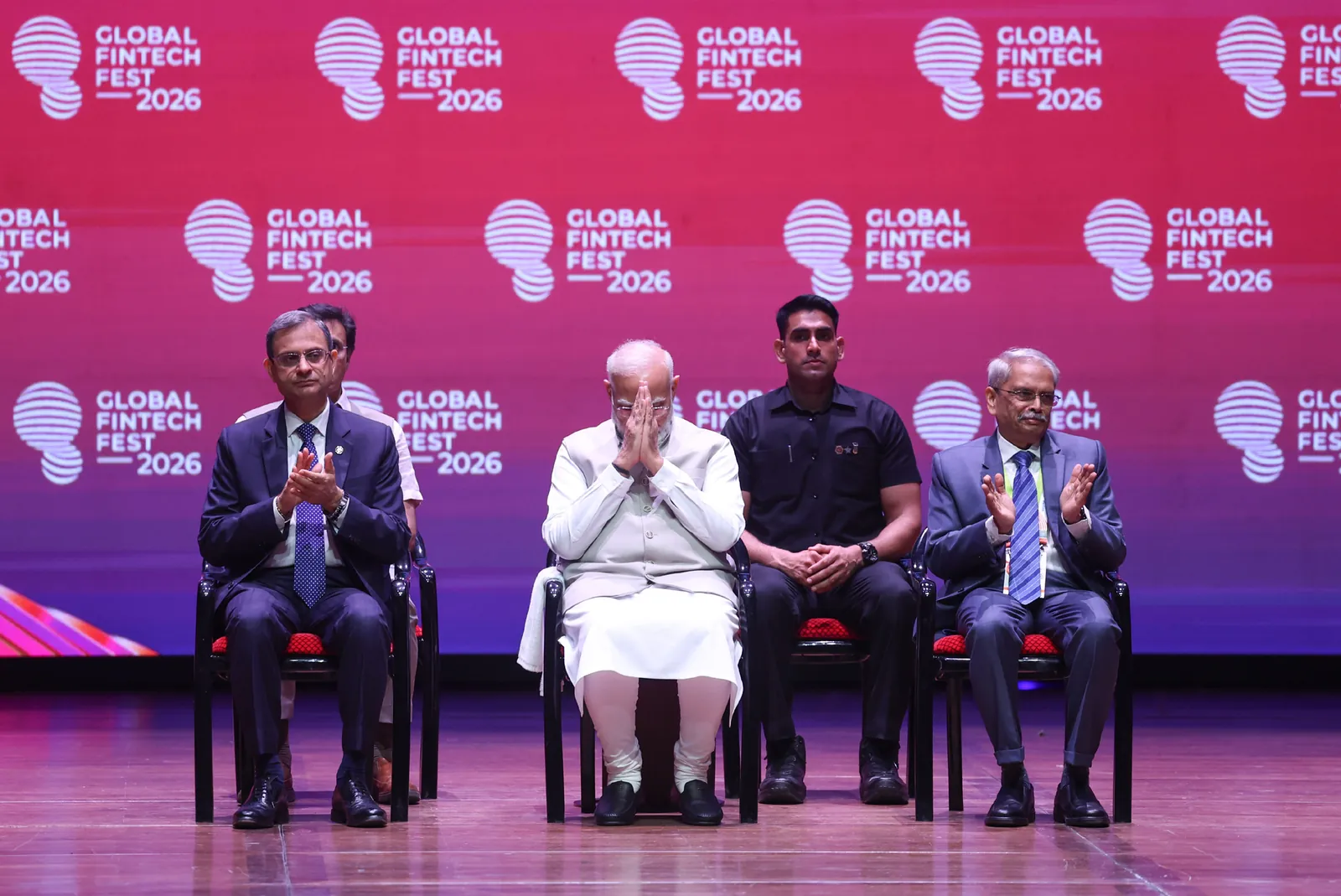
Modi on stage at Global Fintech Fest 2026 in Mumbai, 8 September 2026. Photo: PMO India.
His direction for the industry was to move past payments. More credit, insurance, savings, investment and pension products. UPI connected to the domestic payment systems of partner countries the way it already connects to Singapore, and cheaper remittances for the world’s largest remittance-sending population. He used PM SVANidhi as the proof, saying formal credit lifted street vendors’ average annual income by over 20 percent, and noted the scheme has been extended to 2030.
The government’s own briefing note for the event carries the base numbers. UPI processed 2,365.8 crore transactions worth Rs 29.88 lakh crore in July 2026, with 741 banks live, and volumes up nearly 12,000 times since FY 2016-17. The RBI’s Financial Inclusion Index stood at 70.0 in March 2026, against 43.4 in March 2017. Jan Dhan accounts reached 59.15 crore by 26 August 2026, and Aadhaar enrolments passed 144 crore.
What happened at GFF 2026 beyond payments?
The Prime Minister asked the industry to grow credit, insurance and pensions. The same four days produced news on all three.
PFRDA Chairperson Sivasubramanian Ramann said the regulator has set up a committee to work on a guaranteed-return pension scheme for the non-government sector. He expects NPS Swasthya, a scheme that lets pension savings pay hospital bills with top-up insurance, to launch in about 30 days, according to Business Standard’s report on 10 September.
On insurance, NITI Aayog’s Sanjeet Singh said the government wants to raise insurance penetration from about 3.7 percent to 4.7 percent. He asked insurers to help cover the missing middle, the people between government schemes and private cover, the Economic Times reported on 11 September.
On credit, the Finance Ministry extended Credit Line on UPI to Kisan Credit Card and PM MUDRA borrowers, so their sanctioned limits can pay merchants over UPI. Ten banks have enabled it for KCC and eight for MUDRA, Inc42 reported on 9 September.
On exports, Commerce Secretary Rajesh Agrawal said India’s fintech services exports could grow from about $8 billion to between $60 billion and $80 billion, ET BFSI reported on 9 September.
What did the RBI say at GFF 2026?
The regulator spent its keynote on trust rather than features. Governor Sanjay Malhotra’s 10 September address, Shaping the Next Decade of Finance, framed trust as an operating discipline built transaction by transaction, not a marketing slogan, and asked the industry to treat data as a fiduciary responsibility rather than a business asset. His regulatory line was proportionate and activity-based: same activity, same risk, same regulatory treatment.
The substance underneath it: recognition of the Unified Fintech Forum (UFF), formerly the Digital Lenders Association of India, as the sector’s second self-regulatory organisation, the Unified Lending Interface for consent-based credit, MuleHunter.ai for fraud detection, a proposed Digital Payments Intelligence Platform (its first part, the Smart Registry, went live on 1 September), tokenisation of corporate bonds settled in CBDC run jointly with SEBI, and a Q-SAFE committee on quantum resilience. His figures included 280 billion digital transactions in FY 2025-26, 24 billion UPI transactions a month, 30 fintech unicorns and USD 2.4 billion of fintech funding in 2025.
In his welcome remarks on 8 September he put the last decade more plainly. Fintech has taken banking from the branch to the hand of every citizen.
How far did tokenisation get at GFF 2026?
As far as live bond issues. On 10 September, RBI Governor Sanjay Malhotra and SEBI Chairman Tuhin Kanta Pandey launched Demat 2.0, a pilot for tokenised corporate bonds. REC had raised Rs 500 crore under it on 7 September, and L&T and IIFL Finance followed with Rs 500 crore and Rs 25 crore, according to Business Standard on 10 September.
The bonds are tokens on a ledger that the depositories own and run with the exchanges. The money leg settles in the RBI’s wholesale digital rupee, so the bond and the cash move together. Secondary trading and retail access come in later stages, MediaNama reported on 11 September.
Finance Minister Nirmala Sitharaman used the pilot to push the RBI to take its wholesale and retail CBDC pilots further. Every tokenisation design, she said, “eventually returns to the foundational question: What is the money leg made of?”, PTI reported on 11 September.
Other assets are queued up. An RBI executive director said gold tokenisation is being explored, and Maharashtra is preparing a DELTA Act for land, MediaNama reported on 9 September. Nandan Nilekani described pilots that tokenise cattle and warehouse receipts so lenders can lend against them, according to Inc42 on 10 September.
What did regulators say about AI at GFF 2026?
Regulators, and SBI’s chairman, kept making one point. Software can act, but the institution answers for it.
SEBI Chairman Tuhin Kanta Pandey said SEBI uses AI tools to scan social media and advertisements, but “an AI-generated alert is not a finding” and “enforcement and adjudication cannot be delegated to the black box”, MediaNama reported on 10 September. RBI Deputy Governor Rohit Jain said in a speech on 9 September that “an institution may outsource the computation, but it cannot outsource the consequence.” Deputy Governor Shirish Chandra Murmu said in a speech on 11 September that the RBI’s digital lending rules rest on the same idea: technology “can distribute a service, but it cannot distribute responsibility.”
SBI Chairman C S Setty proposed a know your agent framework covering an agent’s identity, authentication, consent, transaction limits and audit trails, the Economic Times reported on 10 September. Nirmala Sitharaman said she had asked the RBI about a soft-touch approach to regulating AI, and told firms beyond its reach: “Where the regulator’s writ ends, your own standards must begin,” according to MediaNama on 11 September.
We read it as the brief for anyone building agentic products: say who is accountable, on the page.
What did GFF 2026 say about quantum, deepfakes and fraud?
Quantum got a direct request from the regulator. RBI Deputy Governor Shirish Chandra Murmu said in a speech on 11 September that payment system providers and network operators should begin quantum-proofing, citing long migration cycles and the risk that data encrypted today is harvested now and decrypted later. He set no deadline or standard, MediaNama noted. SEBI’s cyber framework already treats quantum computing as a potential threat, ET BFSI reported on 10 September, and UIDAI’s chairman said it is implementing post-quantum cryptography, according to MediaNama on 9 September.
On fraud, the first part of the Digital Payments Intelligence Platform is now working. Its Smart Registry went live with eight banks on 1 September. Another 25 banks are expected within two months and the top 15 payment aggregators by the end of January, MediaNama reported on 11 September. A second phase would give each transaction a risk score before it completes.
FATF Vice-President Vivek Aggarwal said the industry’s realisation of risks from AI, scam compounds and quantum computing “is not there” and that investment is falling short, PTI reported on 10 September. A Maharashtra government official said live video deepfakes can already bypass KYC checks, MediaNama reported on 11 September.
What GFF 2026 says about where Indian fintech is going
Three shifts, in order of how much they change the work.
The payer may not be a person
Amazon Pay’s Smart wallet lets an agent pay. L&T Finance’s PLANET app, using Pine Labs’ payment protocols, lets an agent book a flight inside a limit. The Unified Agent Protocol, now on hold pending RBI clearance, would remove per-transaction approval for small amounts. Once software can spend on your behalf, the product question stops being how to make one tap faster and becomes what did I authorise, where do I see it, and how do I stop it. MyUPI is the consumer-facing answer to that. AtOM, with its signed machine-readable audit trails, is the institutional one. Both launched at the same event, which is not a coincidence.
Distribution is moving off the screen
UPI Tap and Pay works with no internet on the phone. Android ATMs can open accounts at the machine and issue a RuPay card or a merchant UPI QR code in minutes, with no branch visit or courier wait. Mahindra Finance runs collections through voice agents in 12 Indian languages, Yes Bank and Open handle mandate failures in 22. A growing share of these products will be used by people who never open the app, in a language the marketing site is not written in.
Credit is the stated next chapter, not payments
The Prime Minister asked for it directly. The RBI pointed at the Unified Lending Interface. Yubi launched a retail lending marketplace and a credit explainer app. PayU, Paytm, Razorpay, Juspay and Skydo had already picked up cross-border aggregator licences before the event. Payments is the distribution. Credit is where the margin is meant to come from.
One caveat across all of it. Most of this is launch-stage. Piloted with nine lenders is not deployed. Live for flight booking is not live for commerce. Signalled is not shipped. Separate what actually shipped from what was announced before you put any of it in a roadmap.
What we took away from the floor
Our own reading, as the people who build the websites these companies send buyers to. The floor was full of the word agentic and short of plain sentences saying what a product does, who it is for, and what it replaces. A stand gets a few seconds of attention. A website gets slightly longer. They fail the same way when the copy is all adjectives.
There is also a second reader to write for now. When someone asks an assistant which Indian payment companies launched agentic checkout in 2026, the answer gets assembled from pages that state the product name, the partner, the limit and the date in sentences a machine can lift. Pages built from atmosphere do not get quoted. That is a writing problem before it is a design problem, and it is the cheapest thing on this list to fix.
We wrote about the wider run of events before GFF in Fintech Event Season Is a Design Deadline.
Questions people asked us about GFF 2026
What does agentic checkout change for a fintech website?
Two things. The product page has to name what the agent is allowed to do and what limits the user sets, because that is the first question a buyer asks. And the copy has to survive being read by a machine, so the product name, the partner and the date belong in plain sentences rather than inside a diagram.
What is the theme of GFF 2026?
Potential to Impact, built on three technologies, agentic AI, tokenisation and quantum, and framed as Trusted, Connected, Global Systems for Inclusive Finance.
Was GFF 2026 only about payments?
No. The RBI and SEBI launched a tokenised corporate bond pilot, PFRDA said it has set up a committee on a guaranteed-return pension for the non-government sector, and the Finance Ministry opened Credit Line on UPI to Kisan Credit Card and PM MUDRA borrowers. Regulators’ keynotes also covered AI accountability, quantum risk and fraud.
Who organises Global Fintech Fest?
The Payments Council of India, the National Payments Corporation of India and the Fintech Convergence Council, with support from MeitY, the Department of Financial Services, the NEST division of the Ministry of External Affairs, NITI Aayog, the RBI, SEBI, IFSCA and PFRDA.
What did NPCI launch at GFF 2026?
AiNxt, an open-source agentic AI platform, and AtOM, an orchestration platform that creates signed machine-readable audit trails for UPI integration and partner onboarding. RBI Governor Sanjay Malhotra launched two more NPCI features at the event on 10 September: MyUPI and UPI Tap and Pay.
What is MyUPI?
A consolidated view of a user’s UPI transactions and AutoPay mandates across banks and UPI apps, built on FiMI, NPCI’s payments-focused small language model. It was launched at GFF 2026.
What is UPI Tap and Pay?
A feature that lets a user pay by tapping an NFC-enabled phone on a compatible POS terminal with no internet connection on the phone. Payments up to Rs 5,000 are PIN-less. Above that, the UPI PIN is entered on the terminal.
How many UPI transactions does India process?
Prime Minister Narendra Modi said more than 24 billion UPI transactions took place in August 2026. The Government of India’s GFF briefing put July 2026 at 2,365.8 crore transactions worth Rs 29.88 lakh crore, with 741 banks live on the platform.
What is Demat 2.0?
The pilot for tokenised corporate bonds that RBI Governor Sanjay Malhotra and SEBI Chairman Tuhin Kanta Pandey launched at GFF 2026 on 10 September. Bonds are issued as tokens on a ledger that the depositories own and run with the exchanges, and settled in the RBI’s wholesale digital rupee. REC, L&T and IIFL Finance issued Rs 1,025 crore of bonds under it between 7 and 9 September.
What did SEBI say about AI at GFF 2026?
SEBI Chairman Tuhin Kanta Pandey said SEBI uses AI for surveillance, social media monitoring and cybersecurity checks, but that “an AI-generated alert is not a finding” and enforcement cannot be delegated to a black box. He also said growing fast and growing safe are not competing ambitions.
What did the RBI say about quantum computing at GFF 2026?
Deputy Governor Shirish Chandra Murmu said on 11 September that payment system providers and network operators should begin quantum-proofing their systems, because encrypted data collected today could be decrypted later. He did not set a deadline or a standard.
What did Nirmala Sitharaman say at GFF 2026?
In her address on 11 September, the Finance Minister urged the RBI to take its wholesale and retail CBDC pilots further and proposed a federated industry platform to engage foreign regulators. She also called AI a double-edged sword that helps catch fraud but lets attackers automate larger attacks.
Was Rango at GFF 2026?
Yes. The team was on the floor across two days of the festival. Sagar posted two videos from Mumbai, both above, and said Rango will try to make a couple more events before the year ends.
This article was originally published on rango.design. Read the original here: https://rango.design/articles/global-fintech-fest-2026-launches

Sagar Ludhiyani
Published On
Share on